

Blog
A high-tech enterprise specializing in the research and development, production, and import and export trade of rescue equipment

Contact Information
Phone:86 010-51284966
Phone:86 18518110097
E-mail:bjsbl_sale@163.com
Address: Room 403, Building B, Xinhua International Center, Huaxiang, Fengtai District, Beijing
What is an infrared life detector?
2022-03-10
Infrared Life Detector Primarily utilizes infrared night vision technology, combined with video display, to provide images of objects in areas invisible to the user. Infrared camera technology is divided into passive and active infrared camera technologies. Passive infrared camera technology utilizes the principle that any object above absolute zero (-273.15°C) emits infrared radiation. The infrared radiation from human bodies and other warm objects is strong, while that from non-warm objects is weak, allowing for night surveillance using special infrared cameras. Passive infrared camera technology is not widely adopted in night vision systems due to its high cost and inability to reflect the surrounding environment accurately.

What is an infrared life detector? Let's take a brief look together.
Any object above absolute zero emits infrared radiation, and humans are natural infrared radiation sources. However, the infrared radiation characteristics of humans differ from those of the surrounding environment. Infrared life detectors utilize these differences to separate the target from the background. The central wavelength of human infrared radiation is 9.4μm, and the infrared radiation range of human skin is 3-50μm, with 8-14μm accounting for 46% of total radiation energy. This wavelength is a crucial technical parameter in designing human infrared detectors.
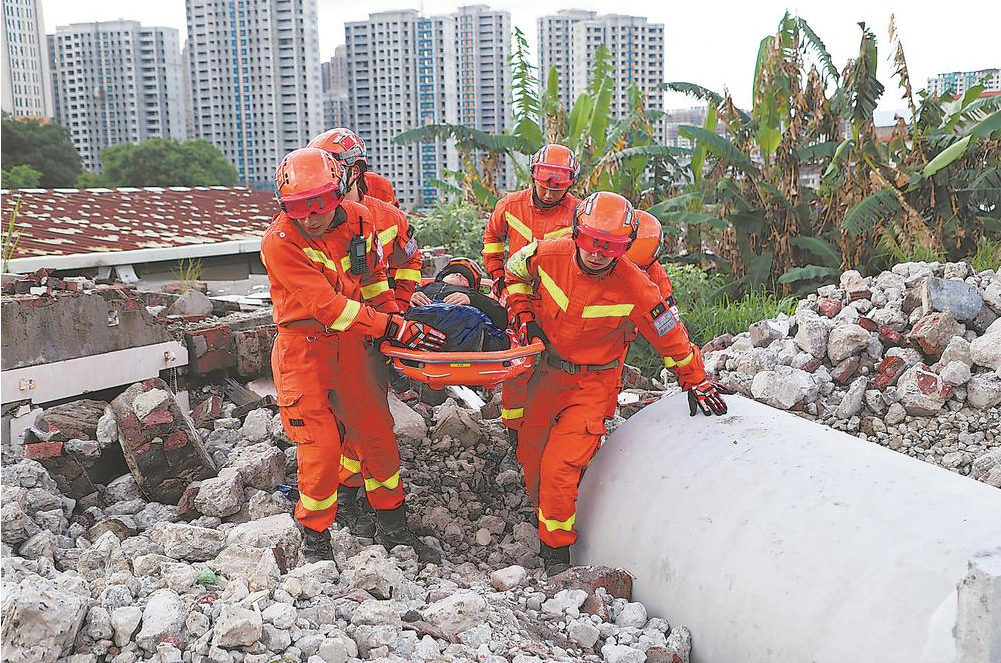
Infrared life detectors can withstand harsh conditions at rescue sites, searching for life in smoky, fiery, and dark environments after earthquakes. The device detects the heat from victims' bodies, and the optical system focuses the received thermal radiation onto an infrared sensor, converting it into electrical signals. After processing, the infrared thermal image is displayed on a monitor, helping rescuers locate victims.
Infrared Life Detector Initially used in the military, infrared technology has been continuously improved with scientific advancements. In 1988, Sweden's AGA launched a full-function thermal imager integrating temperature measurement, correction, analysis, image acquisition, and storage. This technology was used to develop portable full-function thermal cameras, mainly for military investigations. With societal development, countries began developing technologies and equipment to reduce casualties from various disasters, and infrared detection technology shifted from military to rescue applications, leading to the development of infrared life detectors.
Infrared Life Detector Mainly uses visible light, transmitted to the display via a CCD sensor camera. It offers video visualization, recording, and saving capabilities, and allows for computer analysis of the camera scene. The product is intuitive, user-friendly, and inexpensive. Some video life detectors are also equipped with microphones to detect sounds at the search site, providing more intuitive information. Typically, this requires cables for audio signal transmission or use within gaps and holes.
This is a brief analysis of infrared life detectors. Hope this helps!
Contact Information
Phone:8618518110097
E-mail:bjsbl_sale@163.com
Address: Room 403, Building B, Xinhua International Center, Huaxiang, Fengtai District, Beijing
- Official Account -
- Business Inquiry -


