

Blog
A high-tech enterprise specializing in the research and development, production, and import and export trade of rescue equipment

Contact Information
Phone:86 010-51284966
Phone:86 18518110097
E-mail:bjsbl_sale@163.com
Address: Room 403, Building B, Xinhua International Center, Huaxiang, Fengtai District, Beijing
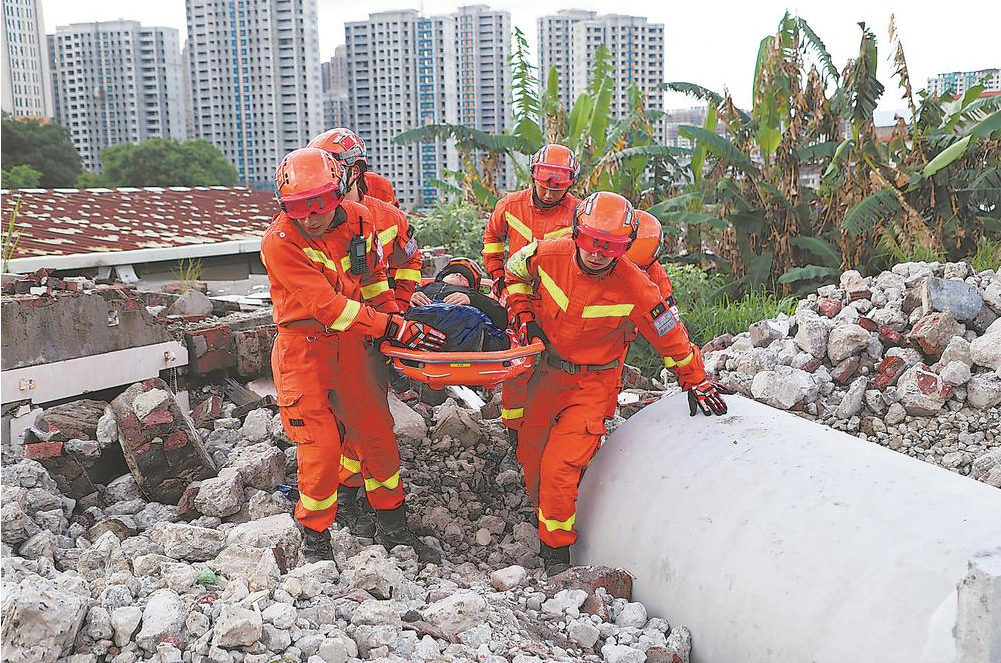
The application of life detectors in personnel search and rescue
2022-01-13
In response to building collapses caused by earthquakes, explosions, or other reasons, based on the principle of "major war, fierce battle", improving the combat effectiveness of the fire brigade in handling various building collapse disasters, in order to minimize casualties for those trapped in precise searches within a short period of time," Life detector "has become one of the commonly used equipment of the fire department.

1. Principle of Life Detector
Life detectors are currently the world's most advanced search and inspection instruments, mainly by detecting the electric field generated by the ultra-low frequency radio waves emitted by the human body (generated by the heart) to locate the position of "living people". The ultra-low frequency electric field emitted by the human body can penetrate steel-solidified walls, steel plates, wooden boards, and even water. Therefore, if there are signs of life, whether it is awake, unconscious, trapped in rubble, or hiding in a container, a life detector can be used to find it in the shortest time. The air combat detection range of the life detector can reach 500 meters, and it can detect life through 80 centimeters of ordinary steel plate.
2. Classification of Life Detectors
Life detector According to the principle and structure, they are divided into: radar wave detectors, image detectors, audio detectors, etc.
Audio detector: Acoustic audio detector - obtains weak sound waves propagating in the air, amplifies the signal to detect the target. Vibration wave audio detector - selects vibration waves from the ground through a vibration probe, amplifies to detect the target. Both have the common characteristics of low price and easy use.
Limitations: The site must have some holes and cracks for the detection equipment to enter, or it is only suitable for shallow surface and large space detection. Therefore, if it rains or there is fire fighting water, it will be subject to a certain degree of environmental interference.
Video detector - transmits to display imaging through a CCD sensor camera, with or without visible light. Video visualization, intuitive, easy to use, low price, generally needs audio signal transmission or gap holes when used.
Radar wave Life detector ——The radar antenna concentrates on emitting electromagnetic waves, which can penetrate concrete walls, rubble, etc., and reflect and change after contacting the human body. This change is affected by body movement, breathing, and even heartbeat activity. The electromagnetic waves that change after reflection are received by the receiver, background interference is filtered, and some unique spectrums are analyzed and processed by computer software and displayed on the display screen. It is easy to carry, moves quickly, does not need to contact the object, does not need to enter holes or gaps, etc., and can detect trapped people when isolated by various substances.
Life detection radar mainly consists of wireless detection emission equipment and a handheld computer. The wireless detection emission equipment first emits radar waves, which can penetrate general building walls and rubble, reaching a test object of up to 6 meters. The movement, breathing, and heartbeat of the target change the radar waves to a certain extent, causing the changed radar waves to return to the handheld computer through the antenna. Through the data processing of professional software in the computer, the corresponding waveforms and signal displays are obtained to judge whether there are survivors within the test range. When operating the detection radar, ensure that the distance between the handheld computer and the wireless detection transmitter is within 1.5~15 meters, and ensure that there is no other suspicious movement within 6.1 meters of the detection antenna. This equipment can usually complete the search within the effective space range within 3 minutes and find other trapped personnel.
Contact Information
Phone:8618518110097
E-mail:bjsbl_sale@163.com
Address: Room 403, Building B, Xinhua International Center, Huaxiang, Fengtai District, Beijing
- Official Account -
- Business Inquiry -


