

Blog
A high-tech enterprise specializing in the research and development, production, and import and export trade of rescue equipment

Contact Information
Phone:86 010-51284966
Phone:86 18518110097
E-mail:bjsbl_sale@163.com
Address: Room 403, Building B, Xinhua International Center, Huaxiang, Fengtai District, Beijing
The importance of infrared life detectors
2021-10-26
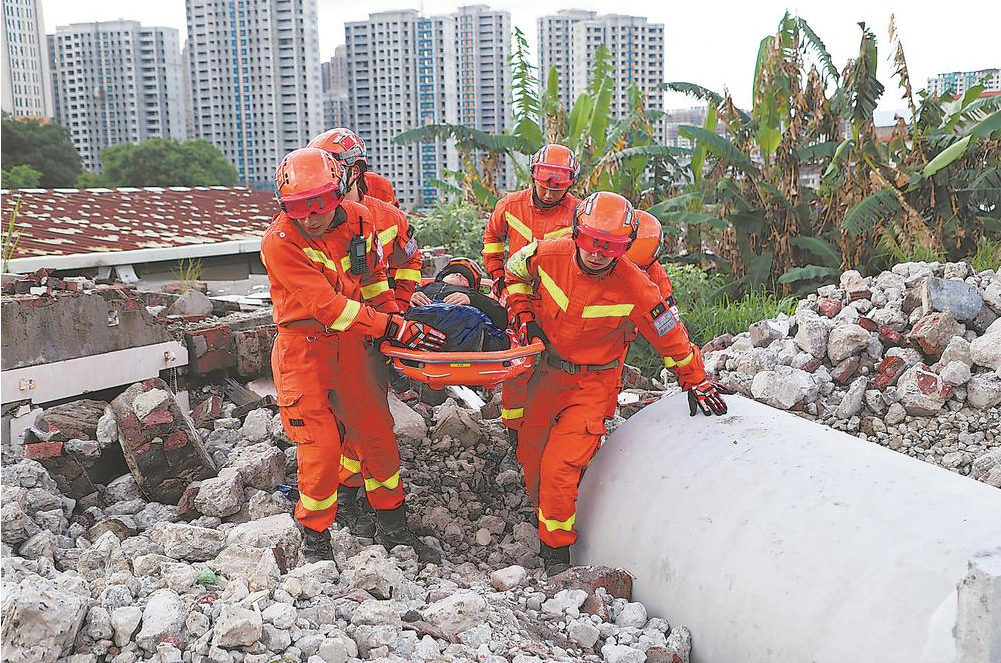
In the absence of search and rescue dogs, what equipment can emergency rescue personnel in earthquake-stricken areas use to locate trapped individuals? The answer is: infrared life detectors.
Speaking of infrared life detectors, we need to introduce the concept of the "golden 72 hours." This refers to the golden rescue period after a geological disaster, a consensus in the rescue (academic) community. The rescue community believes that there is a "golden 72 hours" after a disaster, during which the survival rate of buried personnel is very high. Therefore, finding survivors within these 72 hours has become an important task. This period is also an important time for infrared life detectors to play their role.
The timely discovery of trapped personnel under earthquake rubble and the determination of their specific burial location are prerequisites for implementing earthquake rescue operations. Therefore, it is necessary to use infrared life detector equipment to accurately locate survivors. Portable, flexible, and applicable detection equipment is particularly important. The following commonly used detection equipment has played an important role in earthquake disaster rescue due to its own characteristics.
Infrared life detectors are also known as thermal imaging life detectors. The device itself senses trapped personnel by receiving thermal radiation.
Infrared life detectors rely on the difference in infrared radiation between the human body and the environment to identify survivors. Therefore, it can be used in rescue locations that are difficult for people to reach, such as dark and smoky areas. All objects above absolute zero produce infrared radiation, and the human body is a natural source of infrared radiation. Unlike other objects in the environment, as warm-blooded animals, humans emit infrared radiation in a special constant range. If infrared radiation is found within this range, it is very likely that a survivor has been found, which is the key point of infrared life detector search and rescue.
Acoustic vibration life detectors rely on identifying various sounds emitted by trapped personnel, such as the faint sounds of survivors' heartbeats, breathing, and movement.
Acoustic vibration life detectors have a special set of "auditory organs." Humans have two ears, but this instrument has three to six ears. Its ears are called "vibration sensors," also known as vibration sensors. It can judge the specific location of the survivor based on the subtle differences in the sound sequence heard by each ear. Speech is easy to identify because designers have thoroughly studied human speech frequencies. Experience shows that survivors buried under collapsed buildings can often hear the sounds of rescuers, but rescuers cannot hear them. Concrete and gravel will block all sound waves. However, if the survivor can tap, scratch, or move, the collapsed structure can still effectively transmit these sounds. In other words, even if the survivor is no longer speaking, as long as he taps lightly with his fingers and makes a little sound, he can be heard.
The main body of the optical life detector is very flexible, like an endoscope used for medical examinations in the human body. It can "see" the terrain deep within the ruins, see the location and condition of trapped personnel buried several meters deep under collapsed buildings, can work in narrow spaces in earthquake-stricken areas, and cannot be reached by conventional methods.

Contact Information
Phone:8618518110097
E-mail:bjsbl_sale@163.com
Address: Room 403, Building B, Xinhua International Center, Huaxiang, Fengtai District, Beijing
- Official Account -
- Business Inquiry -


