

Blog
A high-tech enterprise specializing in the research and development, production, and import and export trade of rescue equipment

Contact Information
Phone:86 010-51284966
Phone:86 18518110097
E-mail:bjsbl_sale@163.com
Address: Room 403, Building B, Xinhua International Center, Huaxiang, Fengtai District, Beijing
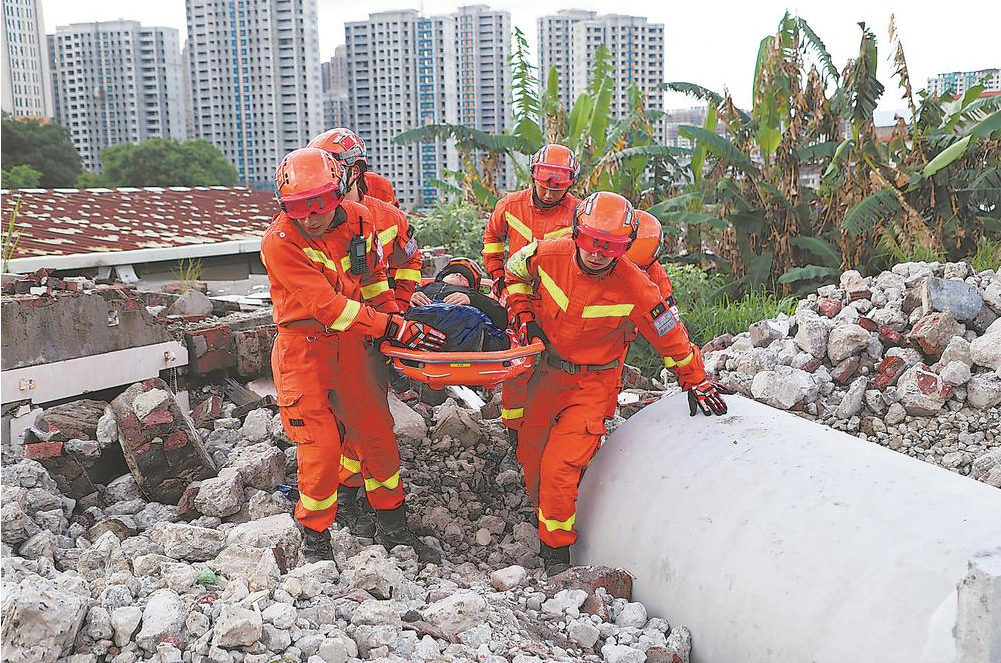
Focus on fire protection: "Shanxi Provincial Fire Rescue Team conducts high-rise building fire fighting and rescue drills"
2021-06-01
On the morning of May 31, the Shanxi Provincial Fire and Rescue Corps organized a high-rise building fire rescue drill at the Swan Hotel in Linfen City.
The drill used a high-rise building fire at the Swan Hotel as its background. Following the "Emergency Response Plan for High-Rise Building Fires" of the Shanxi Provincial Fire and Rescue Corps, a level three fire response was initiated. 355 firefighters, 45 rescue vehicles, and over 5,000 pieces (sets) of various rescue equipment were deployed. Thirteen drill stages and 40 practical subjects were set up, including unit self-rescue, alarm dispatch, en-route decision-making, communication support, vehicle parking, fire investigation, organization and command, smoke removal and detoxification, safety control, facility application, search and rescue, fire extinguishing operations, and fire scene water supply.
This drill focused on practical needs and innovatively adopted a demonstration and teaching-style drill model. Following the organizational process of "thematic study—battle case review—tabletop exercise—practical training—inspection and evaluation," it provided a standardized demonstration of high-rise building fire rescue operations.
Integrating education with combat and adhering to a practical orientation. The drill conducted an in-depth review of typical cases of high-rise building fire handling from recent years at home and abroad, actively promoting the organic integration of thematic study and practical training. It moved the classroom to the field and integrated theory into combat, making full use of the digital pre-plan system to realistically simulate fire scenes and conduct simultaneous drills and tactical discussions. This avoided single, theoretical lectures, effectively improving the "combat content" of theoretical research, and building a "study—training—combat" work cycle.
Promoting combat through drills and establishing practical benchmarks. The drill adhered to the principle of "simultaneous advancement and adaptation" of standards, specifications, and practical applications. It detailed the familiarization content for two-level commanders and six types of personnel, clarifying the "eight must-test" familiarization test procedures for the number of water supply hoses, water supply capacity, indoor and outdoor fire hydrants, fire control room, communication signals, aerial fire trucks, pump connectors, and fire elevators. It showcased self-developed equipment such as the safety officer's carrying case and cat's eye water gun, standardized practical methods such as dispatching search and rescue, rapid initial fire reconnaissance and control, and thermal convection prevention, and refined the new operational safety control model of "two-level control, timed inquiries, and proactive reporting."
Innovating combat research and deepening practical application. The drill summarized and compiled six types of commonly used action guidelines, including drill evaluation, disposal teams, and pre-plan preparation. It refined and condensed 18 easily remembered, easily mastered, and operable combat points, including the "five inquiries" key points for high-rise building fire alarm handling (address, type, substance, personnel, fire situation), the "three exhaust" principles for smoke removal and detoxification (downwind exhaust, high-altitude exhaust, positive and negative pressure exhaust), and the "six must-search" requirements for internal search (elevators, bedrooms, bathrooms, behind doors, ends of corridors, and under beds). Simultaneously, a display of innovative equipment achievements and innovative subject practical demonstrations were conducted; multi-level and multi-dimensional inspection and evaluation further solidified experience and identified loopholes, ensuring the effectiveness of the drill.
The Shanxi Provincial Fire and Rescue Corps will use this drill as an opportunity to further focus on practical needs, optimize drill models, build elite troops, and fully prepare for all fire rescue work.



Contact Information
Phone:8618518110097
E-mail:bjsbl_sale@163.com
Address: Room 403, Building B, Xinhua International Center, Huaxiang, Fengtai District, Beijing
- Official Account -
- Business Inquiry -


