

Product Center
A high-tech enterprise specializing in the research and development, production, and import and export trade of rescue equipment
Latest Products
Description

Contact Information
Phone:86 010-51284966
Phone:86 18518110097
E-mail:bjsbl_sale@163.com
Address: Room 403, Building B, Xinhua International Center, Huaxiang, Fengtai District, Beijing
model:
ZLST-40/120PMSBL
Product Model:
Radar life detector
Next Page
Radar Life Detector (National Inspection)
Brand: Sheng Bolan
Model: ZLST-40/120PMSBL
The radar-based life detection device, which utilizes two-dimensional bio-radar technology, is developed using a combination of ultra-wideband radar technology with extremely low power consumption and biomedical engineering techniques. The system employs a multi-transmitter and multi-receiver imaging array technology, enabling precise localization of living beings within a specific area. This allows for rapid detection and positioning at rescue sites, facilitating swift and targeted rescue operations. The device boasts several advantages, including wide spatiotemporal coverage, high measurement dimensionality, excellent performance stability, and superior spatial resolution of targets. Moreover, it provides more comprehensive and accurate information about both the living beings and the surrounding environment at disaster sites, offering a solid decision-making basis for developing efficient and feasible rescue plans, thereby shortening rescue times and minimizing disaster-related losses. It finds extensive application in specialized fields such as firefighting, earthquake response, and emergency incident management.
Radar life detector Has penetration function It can penetrate materials such as rubble, walls, concrete, soil, rock, and wood; it cannot display an image or produce sound, but it can only determine whether a living organism is stationary or in motion.
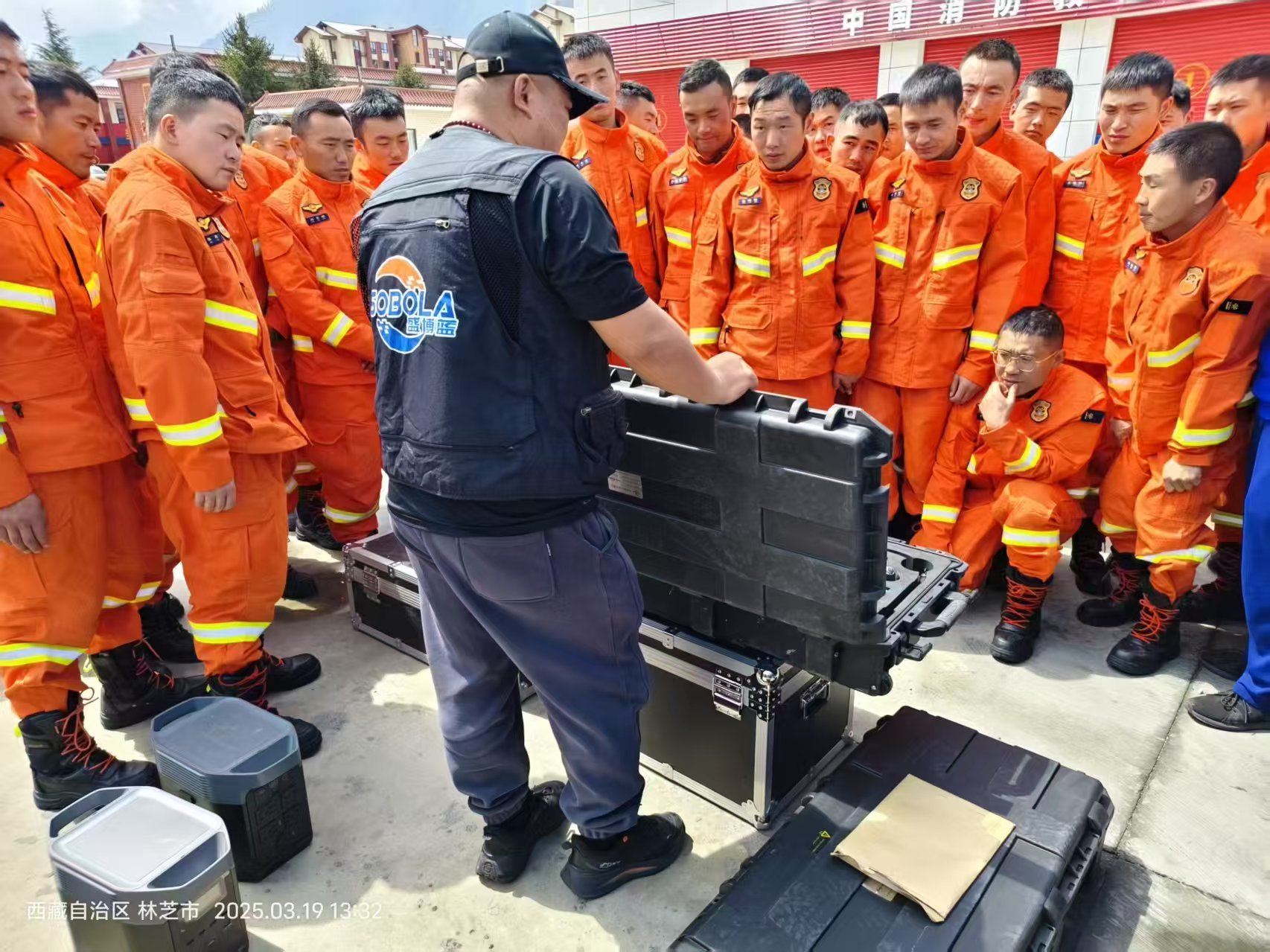
Primarily used for post-earthquake rubble rescue, it can conduct large-scale searches for trapped individuals within collapsed buildings. , Can be applied to living organisms Regional location, precise positioning , Quickly obtain signals from trapped individuals to help rescue personnel rapidly deploy rescue operations.
1. Scanning and Display Function: The detector is equipped with layered scanning and search capabilities for the target area, features two-dimensional positioning, and can acquire the two-dimensional coordinates of living organisms and display them on the control and monitoring terminal.
2. Equipped with intelligent detection functionality: Using advanced algorithms, the system automatically determines whether a living organism is present and distinguishes between moving and stationary targets. It also offers a feature to select whether to display or hide target trajectories. Detected human movements and stationary targets (including breathing patterns) are displayed on the screen using different colored graphical icons. A green icon with a motion trajectory represents a moving target, while a red humanoid icon represents a stationary target.
3. Detection angle range: 122° in the horizontal direction; 121° in the vertical direction.
4. Detection false-negative rate: 10%
5. Power supply duration: 12 hours of continuous operation at full battery capacity.
6. Battery Type: Removable and replaceable rechargeable battery; standard configuration includes 2 batteries.
7. The radar unit features an integrated, three-proof design: waterproof, dustproof, and shock- and impact-resistant, with a protection rating of IP67.


keyword:
Life detection
Product Name:
Previous Page
Related Cases


Online Message
Thank you for choosing us! Every message you leave is a driving force for us to move forward. Our assistant is sitting with a laptop waiting to reply to you
Contact Information
Phone:8618518110097
E-mail:bjsbl_sale@163.com
Address: Room 403, Building B, Xinhua International Center, Huaxiang, Fengtai District, Beijing
- Official Account -
- Business Inquiry -


